
The Distinguished Flying Cross
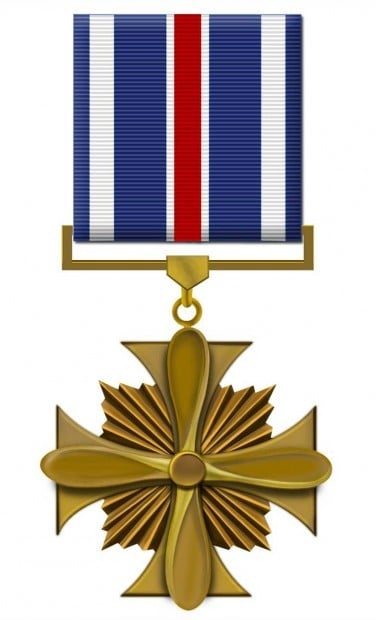
According to the Distinguished Flying Cross Society (dfcsociety,org), “The Distinguished Flying Cross medal is awarded to any officer or enlisted person of the armed forces of the United States for heroism or extraordinary achievement while participating in aerial flight. ... The DFC is the fourth highest award for heroism and the highest award for extraordinary aerial achievement. The award was authorized by an Act of Congress on July 2, 1926. Executive Order 4601 of March 1, 1927 established the rules and regulations pertaining to the award.”
The DFC Society is a nonprofit, national organization dedicated to honoring, preserving, and teaching the history and traditions of the men and women who have been awarded the Distinguished Flying Cross. The Society was founded in 1994 and is headquartered in San Diego, California. Members are DFC recipients who either joined the Society or whose loved ones made them posthumous members.
The decoration can be awarded for actions occurring after 6 April 1917. The intent was to include deserving WWI aviators, though only one WWI aviator has received the DFC. That was Captain James Ely Miller, Commander of the 95th Aero Squadron (posthumous). However, the earliest event that led to awards of the DFC was the first heavier-than-air flight at Big Kill Devil Hill in Kitty Hawk, North Carolina, on 17 December 1903. Since the law permits awards only for aerial events after 1917, Congress passed special legislation to award the DFC to Wilbur Wright (posthumously) and to Orville Wright. Captain Charles Augustus Lindbergh received the first physical DFC medal for his solo trans-Atlantic flight in the Spirit of St. Louis on 20-21 May 1927. Several Hollywood stars of the 1930s and 1940s were awarded the DFC for actions as USAAF aviators in WWII, including Jimmy Stewart and Clark Gable. Wikipedia has a long, interesting list of well-known recipients of the DFC.
About 27 women have been awarded the DFC. The first award was to Amelia Earhart for her solo trans-Atlantic flight, the first woman to duplicate Lindbergh’s accomplishment. This award was followed by awards to three USAAF Flight Nurses for actions in WWII: 1Lt Aleda E. Lutz (posthumous), 1Lt Roberta Ross, and Captain Mary Hawkins. Then came Colonel Jackie Cochran, USAF, who was awarded the DFC three times for setting aerial speed records. The next award that we’ve found was presented to Captain Patricia A. McFetridge, U.S. Coast Guard (ret.), who was the first woman USCG aviator to receive the DFC, along with the rest of her aircrew, for a dangerous, difficult at-sea rescue operation in 1990. Following these eight awards, there were nine awarded in the 2000s, and ten more awards since the 2000s.
It has been estimated that more than 20,000 awards of the DFC have been made. The Honor Roll of the DFC Society includes about 8,000 awardees. About 4.5% of recipients have received the award twice, and about 2% have received the award three or more times. Often, one is humbled when reading the citation to accompany a DFC award because of the extreme commitment displayed, under intense conditions or enemy fire, to save lives or to complete an essential mission.
Dr. Miller is retired from a career in applied research concerning the causes and effects of cognitive fatigue in transportation systems. He served on active duty in the USAF from 1966 to 1971. In 1968 through 1970, he flew nearly 700 combat sorties in Vietnam as a tactical transport pilot in the Lockheed C-130E Hercules. He was awarded the DFC and five Air Medals. Presently, he serves as the newsletter editor for the DFC Society and as Secretary/non-Treasurer of the Coastal Bend Chapter of the Society. He is a Life Member of the VFW. He and his wife, Joy, now live in Wilson County.
- Details
- Written by: James C. Miller, Ph.D.
- Category: News
- Hits: 143